REACTOR, FUEL CYCLE and UK SUPPLY CHAIN
Advanced nuclear technologies like the Small Modular Reactor (SMR) are a key pillar of energy transition leadership. Quasar Energy, sponsored by Madhvani International (MISA) is leading the establishment in the UK of a FOAK 1.2GWe privately-led SMR power generation project. SMRs are cost competitive with less capital cost per MW when compared with large GW-scale nuclear reactors.
In the last few years there has been significant and growing global interest in SMRs. The USA, Canada, Poland, Estonia, Argentina, Czech Republic, and several others (excluding China and Russia) are well ahead of the UK, with agreements in place with utilities and companies to deploy SMR technology.
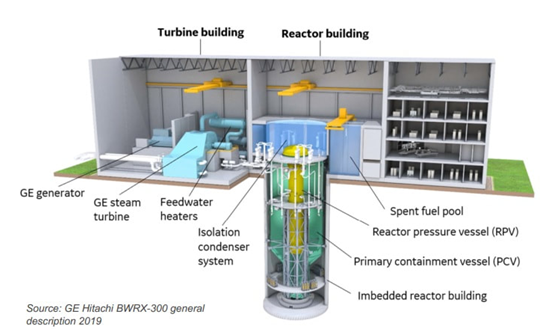
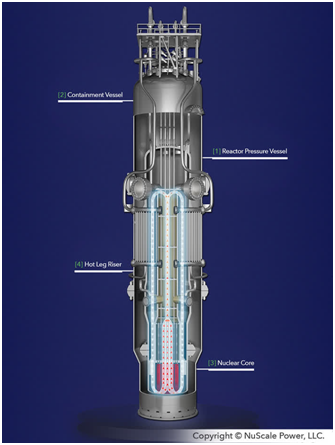
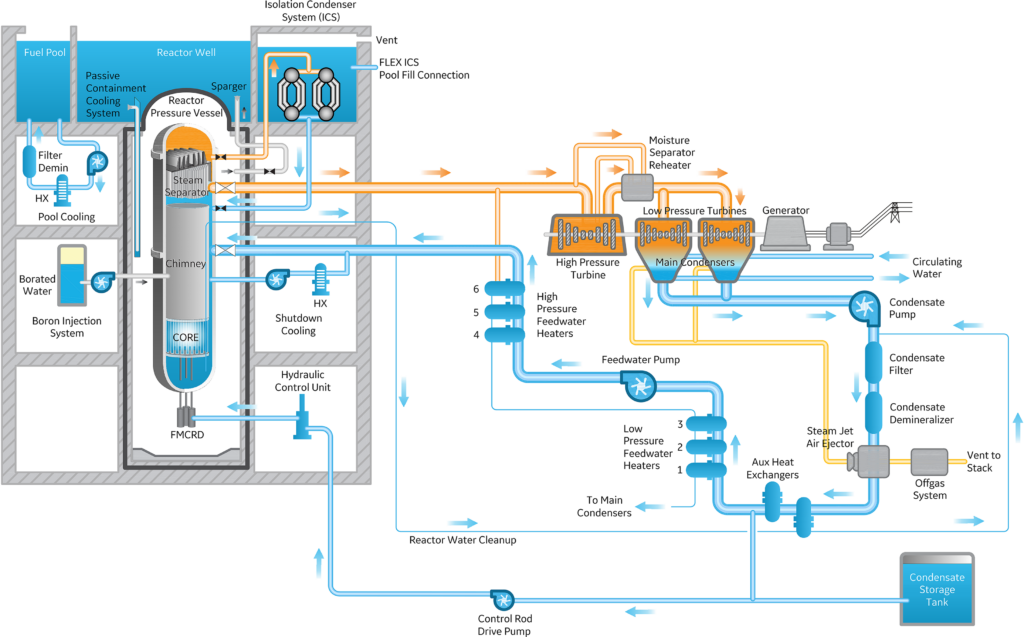
As “smart reactors”, the SMR uses natural circulation and passive cooling isolation condenser systems to promote simple and safe operating rhythms. In the global race for advanced nuclear power, these technologies set themselves apart with proven, less complicated processes.
QUASAR DEVELOPMENT TO DATE
Since 2019 and after rigorous and independent evaluation and analysis of available technologies, MISA selected GE-Hitachi’s BWRX-300 SMR as the reference technology. With discussions commencing in 2020, a Memorandum of Understanding (MoU) was concluded in 2021. A 4-year intensive effort was undertaken to determine the technical and financial feasibility of establishing Quasar as the FOAK 1.2GWe 4-unit SMR power generation project. The ambition was for COD in 2028/29.
Madhvani International was also directly in contact with OPG in Canada seeking to emulate that project being developed in Darlington, Ontario.
In the meantime, very many technologies had commenced development of SMR designs.
In November 2024, GE-Hitachi then restructured as ‘GE Vernova’(GEVH) decided to apply to compete in DESNZ’s technology competition and the collaboration with MISA is presently in abeyance.
A final technology selection is planned in 2026/2027 following comprehensive technical, commercial, and regulatory assessment completed to-date.
ALTERNATIVE ROUTES TO MARKET
Pursuant to DESNZ policy during 2024/25, Quasar committed to explore the UK Government’s Alternative Routes to Market to maintain its focus to become a private owner/ investor/ power generator to establish the UK’s FOAK 1.2GW SMR capacity.
TECHNOLOGY SELECTION AND NET-ZERO
SMR technologies produce no carbon during operation and are designed to achieve construction and operating costs that are substantially lower than traditional nuclear power generation technologies.They incorporate world class safety systems; steam condensation and gravity designs allow the SMR to cool itself for a minimum of several days without power or operator action. The reactor permits quick deployment: OPG is targeting 2028/29 for first deployment employing up-to-date SMR know-how and modern construction techniques
Quasar will deliver Small Modular Reactors (SMRs) using proven, licensable light-water reactor technology and a scalable fleet-based deployment model. Developed in close collaboration with the UK SMR supply chain, the project is designed to minimise regulatory, construction, and delivery risks while supporting a strong domestic nuclear manufacturing capability.
Quasar prioritises reactor technologies based on established operating technologies avoiding first-of-a-kind reactor designs and fuels that avoids unnecessary complexity or regulatory delay. Technology selection is guided by regulatory readiness and a clear pathway through the UK’s Generic Design Assessment (GDA) process, ensuring confidence in both licensing and project timelines.
Quasar is currently engaging with the technology vendors that include Westinghouse AP300, Holtec, CANDU, Rolls-Royce, KEPCO’s https://www.kepco-enc.com/ menu.es? mid= a 20202040200and GE-Hitachi’s BWRX-300 SMRwhich would deliver Quasar’s 1.2GWe of generation capacity through the ultimate deployment of four 300 MW reactors (or equivalent) during the first phase.
FUEL SIMPLICITY
Alongside technology selection, Quasar is developing a secure and fully integrated fuel-cycle strategy aligned with UK nuclear fuel supply and waste management policy. The project intends to enter into a through-life fuel supply agreement with the selected fuel supplier approved by the reactor vendor, ensuring continuity of fuel supply from initial core loading through future refuelling cycles.
For the BWRX-300, arrangements were agreed with GE’s associated fuel manufacturer in Spain. For the AP300 reference design, discussions with the technology provider may enable secure delivery from the Springfields facility, supporting domestic fuel fabrication capability and contributing to the resilience of the UK nuclear fuel supply chain. For CANDU the outcomes by the Regulator will determine fuel source, supply security and waste disposal.
Quasar’s approach is to support security of supply, long-term market demand and encourage sustained investment in UK nuclear infrastructure. Quasar’s fuel programme aims to strengthen domestic manufacturing, fuel fabrication, and supply-chain capability while enhancing energy security.
Quasar takes a full lifecycle approach to project responsibility. Spent fuel management, radioactive waste handling, decommissioning, and long-term disposal obligations are incorporated into the project structure from the outset, with dedicated financial provisions to ensure these responsibilities are fully funded. Our work is for all fuel-cycle and waste-management arrangements to be in compliance with UK regulatory requirements and national policy, pursuant to the UK Government’s Statement on Civil Nuclear Fuel Use and future Geological Disposal Facility requirements.
Through its combination of proven technology, secure fuel arrangements, strong UK supply-chain participation and disciplined delivery model, Quasar aims to provide reliable, low-carbon nuclear generation while establishing a replicable platform for future SMR deployment across the UK.
PROJECT DELIVERY ON-TIME/ON-BUDGET AND UK SUPPLY CHAIN
Quasar’s project delivery strategy is centred on modular construction, early design freeze and a fixed-price engineering, procurement and construction (EPC) model. Quasar is well advanced in its selection of an internationally recognised EPC Contractor for replicating construction and installation of multiple reactor units for the project to benefit from standardisation, learning and scale efficiencies, improving schedule certainty and reducing costs over successive deployments.
In 2023, MISA concluded the Declaration of Intent with a leading UK supply chain for the significant proportion of the Nuclear Island to be sourced from UK suppliers, with an ambition to maximise factory-based manufacturing to assure quality, productivity, and repeatability. Building on more than 80 years of experience in manufacturing and development, they are collaborating with technology vendors to reduce the scale and complexity resulting in an SMR that is modularised, smarter, safer, faster, and less costly to both build and operate. The construction technologies incorporated into these designs adopt advanced concrete solutions and innovative techniques that have been proven in the aircraft, oil and gas, tunnelling, and power industries.
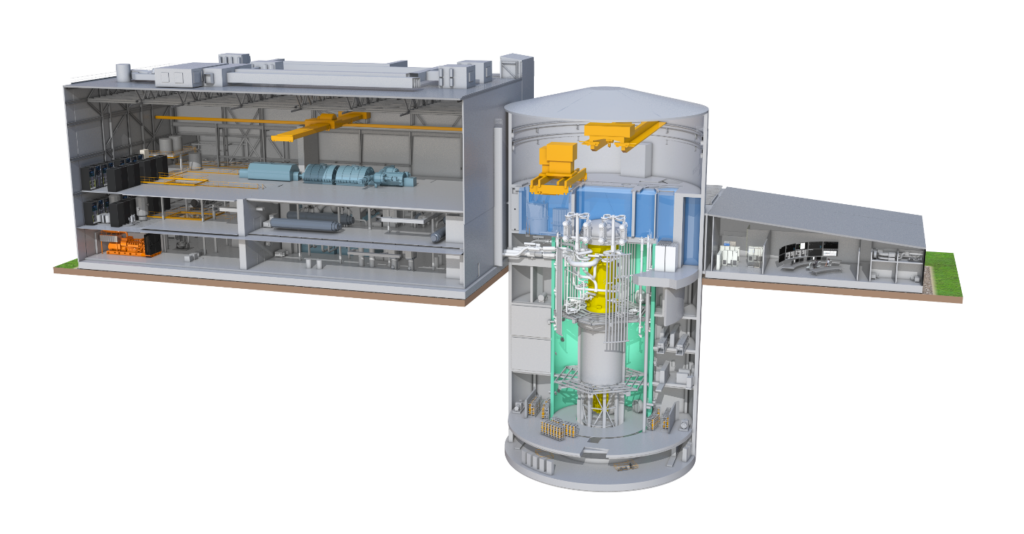
The Quasar SMR delivery represents a significantly dramatic improvement in both affordability and advantageous size. The planned UK supply chain working with Quasar is leading the probability that the UK will become amongst the world’s leaders in supplying advanced nuclear projects’ Nuclear Island. With a combination of modular and open-top construction techniques, the SMR can be constructed in 24-30 months while achieving an approximate 90% volume reduction in plant layout and c.50% per MW for the building. Hence 50% less concrete per MW.